Greater Manchester Mayor Andy Burnham has outlined an ambitious plan to accelerate the city-region’s long-term economic growth, announcing the creation of five globally competitive growth clusters designed to reindustrialise the region and generate high-value jobs for the future.
Speaking at a conference organised by the Institute for Fiscal Studies and University College London, the Mayor described the clusters as the backbone of a new industrial strategy—one that builds on Greater Manchester’s existing strengths while preparing its workforce for the demands of a rapidly evolving economy.
Over the past decade, Greater Manchester has established itself as the fastest-growing economy in the UK, recording average annual growth of 3.1% since 2015, with productivity rising faster than the national average. The new cluster strategy aims to lock in that momentum and extend opportunity across the entire city-region.
Five sectors driving future growth
The cluster plans focus on sectors where Greater Manchester already holds a competitive advantage, supported by world-class universities, research institutions, and a strong private-sector base. Each cluster is designed to concentrate talent, innovation, and investment in defined locations across the region.
Advanced Materials and Manufacturing
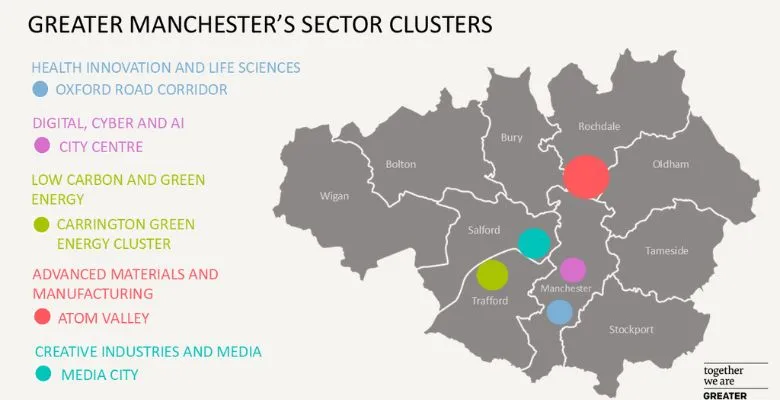
Home to around 500 businesses employing 15,000 people, this sector connects Manchester city centre with Atom Valley, a developing supercluster spanning Bury, Oldham and Rochdale. The area will also host a new Sustainable Materials and Manufacturing Centre, strengthening the region’s position in high-value production and applied research.
Digital, Cyber and AI
Greater Manchester’s £5 billion tech ecosystem is the largest AI sector by headcount outside London and the South East. Strengths in cyber security, fintech and e-commerce are underpinned by leading research institutes clustered around the city centre.
Health Innovation and Life Sciences
The Oxford Road Corridor forms one of the UK’s most intense concentrations of health innovation and life sciences R&D. Located just minutes from The Christie—Europe’s largest single-site specialist cancer centre—the cluster combines research, clinical excellence and commercialisation at scale.
Creative Industries
With the largest concentration of creative businesses outside London, Greater Manchester’s creative economy spans MediaCity in Salford alongside grassroots production hubs and internationally recognised arts and cultural venues.
Low Carbon and Net Zero Technologies
The city-region already supports more than 3,000 low-carbon firms, employing nearly 60,000 people and generating close to £9 billion annually. Growth will be further boosted by the development of the world’s largest liquid air energy storage plant in Carrington, backed by £300 million of investment.
A blueprint for reindustrialisation
Launching the strategy, Andy Burnham described the plans as the first time Greater Manchester has formally mapped its industrial future:
“We are publishing for the first time our cluster map: five defined locations across our city region which, as this century develops, will host industrial clusters of growing global significance.
“This is a concrete plan to reindustrialise the birthplace of the industrial revolution, bringing high-value employment to all parts of Greater Manchester.”
Backing growth with investment and skills
The growth clusters are supported by a £1 billion Good Growth Fund, which will invest in high-impact housing, employment and regeneration schemes. The first round of funding covers 17 projects, expected to deliver nearly 3,000 new homes, over 22,000 jobs, and 2 million square feet of employment space, including major regeneration in Stockport town centre. Further projects are set to be considered in March 2026.
Skills development forms a central pillar of the strategy. Initiatives include the launch of the Manchester Baccalaureate, alongside commitments from local businesses to create more than 1,000 T Level placements. The Mayor also renewed calls for greater devolution of skills and training powers, arguing that fast-growing sectors require a more responsive system.
“The highly specific nature of activities within our clusters means employers need a far more agile and integrated skills system than exists today,” Burnham said.
“We believe the city-region should be able to commission its skills system directly to meet the needs of our fast-changing economy.”